When managing a facility, maintenance department, manufacturing plant, military installation, utility operation, or government project, tool storage security is about far more than simply locking a toolbox. Organizations must balance access control, accountability, productivity, and asset protection across multiple employees, shifts, departments, and locations.
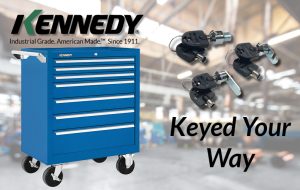
One of the often-overlooked advantages of working with Kennedy® Manufacturing is the ability to configure tool storage solutions with lock systems that meet the specific needs of your operation. Whether you need every toolbox keyed alike for convenience or uniquely keyed for maximum security, Kennedy® has the flexibility to support facility-wide projects of virtually any size.
For organizations purchasing multiple toolboxes, cabinets, mobile workstations, or chests, the ability to specify locking configurations can make a significant difference in both efficiency and security. Let’s explore how keyed-alike and keyed-different solutions can benefit your operation and why Kennedy® Manufacturing remains a trusted partner for industrial storage projects.
The Growing Importance of Tool Storage Security
In today’s industrial environments, tool storage is no longer just about organization. Facilities face increasing pressure to safeguard valuable equipment, control inventory, reduce replacement costs, and maintain accountability.
The loss of critical tools can create several challenges:
- Production delays
- Increased replacement expenses
- Safety concerns
- Inventory discrepancies
- Reduced employee productivity
- Compliance issues in regulated environments
As tool inventories grow in both size and value, controlling access becomes increasingly important. The lock system selected for tool storage often plays a critical role in achieving those objectives.
Understanding Keyed-Alike Configurations
A keyed-alike system means multiple storage units operate with the same key.
Imagine a maintenance supervisor responsible for twenty different Kennedy® tool cabinets spread throughout a manufacturing facility. Rather than carrying twenty different keys, the supervisor can access every designated cabinet using a single key.
This approach offers several benefits.
Simplified Access
One key can unlock multiple storage units, reducing the burden on employees who require access to several tool storage locations throughout the day.
Personnel no longer waste time searching for the correct key or managing large key rings. This translates into greater efficiency, especially in maintenance, repair, and operations environments where quick access to tools is essential.
Easier Key Management
Facility managers often oversee dozens or even hundreds of locking storage units.
A keyed-alike configuration helps streamline:
- Key issuance
- Employee onboarding
- Supervisor access
- Spare key management
- Key replacement programs
This reduction in complexity can save administrative time while minimizing the risk of misplaced or incorrectly assigned keys.
Ideal for Department-Level Control
Many facilities choose keyed-alike configurations for specific departments.
For example:
- Maintenance department storage
- Tool crib cabinets
- Facilities management toolboxes
- Quality assurance equipment storage
- Mobile maintenance carts
Employees within a department can access approved storage units without requiring separate keys for each box.
When Keyed-Different Makes More Sense
While keyed-alike systems offer convenience, some facilities prioritize security and accountability above all else.
A keyed-different configuration assigns a unique lock and key combination to each storage unit.
This approach provides a higher level of individual control.
Increased Accountability
When each toolbox has its own unique key, organizations gain clearer ownership and responsibility.
Individual employees can be assigned specific storage units, making it easier to determine:
- Who has access
- Who is responsible for inventory
- Where tools belong
- When shortages occur
This level of accountability can be particularly valuable in highly regulated or mission-critical environments.
Better Asset Protection
Certain employees may require access only to the tools they use.
Unique keying limits unnecessary access while helping reduce the possibility of:
- Unauthorized borrowing
- Tool loss
- Inventory discrepancies
- Cross-shift confusion
Facilities that maintain expensive precision instruments, specialty tooling, or calibrated equipment often prefer this approach.
Enhanced Security for Sensitive Applications
Keyed-different solutions are commonly used in:
- Aerospace facilities
- Defense contractors
- Government installations
- Utility operations
- Research laboratories
- Specialized manufacturing environments
In these settings, controlling access to equipment is often a critical operational requirement.
A Hybrid Approach for Larger Facilities
One of the greatest advantages of specifying lock configurations during a Kennedy® toolbox project is flexibility.
Many organizations find that a hybrid solution offers the best balance between convenience and security.
For example:
Department-Based Keying
Each department operates under its own keyed-alike grouping.
Examples might include:
- Maintenance Team A
- Maintenance Team B
- Facilities Department
- Quality Department
- Production Support Team
Within each group, a common key works across multiple storage units. Between departments, however, keys remain unique.
Supervisor Override Strategies
Facilities can also designate select storage units for supervisory access while maintaining unique keys for employee toolboxes.
This structure provides:
- Operational flexibility
- Controlled access
- Employee accountability
- Reduced security risk
Project-Specific Lock Configurations
Large industrial projects often require dozens or even hundreds of storage units.
Kennedy® Manufacturing can support project-specific requirements that align with the customer’s access policies and operational workflows.
Whether the requirement is all boxes keyed alike, all boxes keyed differently, or strategically grouped keying arrangements, planning lock configurations at the time of purchase helps ensure a seamless deployment.
Why Key Planning Matters Before Purchase
Many buyers focus on the size, color, drawer capacity, and mobility of tool storage while overlooking lock requirements.
Unfortunately, lock planning after installation can become more complicated and costly.
Early planning allows organizations to address:
Personnel Access
Who needs entry to which storage units?
Shift Coverage
Will multiple shifts share storage locations?
Facility Expansion
Will additional storage units be added later?
Contractor Access
Will temporary personnel require controlled access?
Security Policies
Are there customer, military, or compliance requirements governing tool control?
Answering these questions early helps establish a lock strategy that supports long-term operational needs.
Supporting Government and Institutional Projects
Kennedy® Manufacturing has extensive experience serving industrial customers, military users, educational institutions, and government organizations.
Many of these projects require:
- Large quantities of storage units
- Consistent product specifications
- Access control planning
- Long lifecycle expectations
- Secure equipment storage
The ability to specify locking arrangements becomes especially valuable when deploying storage systems across numerous buildings, departments, or field locations.
Whether supporting a military maintenance operation, municipal fleet garage, public utility, or manufacturing plant, properly planned keying configurations help improve both security and efficiency.
Reducing Downtime Through Better Access Management
The true cost of poor access control often extends far beyond replacing a lost key.
Consider the impact when:
- Employees cannot access critical tools
- Supervisors spend time locating keys
- Tool inventories become disorganized
- Maintenance activities are delayed
A thoughtfully designed keying program helps reduce these disruptions.
When technicians know exactly where tools are stored and can access them quickly, productivity improves and downtime decreases.
For facilities operating around the clock, those time savings accumulate rapidly.
Kennedy’s Commitment to Industrial Durability
Of course, lock configurations represent only one part of the overall value equation.
Kennedy® Manufacturing’s reputation has been built on producing industrial-grade storage designed for demanding work environments.
Customers continue to choose Kennedy® because of features such as:
- Heavy-duty steel construction
- Durable finishes
- High-capacity drawers
- Precision storage organization
- Long service life
- American manufacturing heritage
When paired with a lock system tailored to the customer’s access requirements, these storage solutions become an even more powerful asset management tool.
Choosing the Right Keying Strategy
Determining whether to select keyed-alike or keyed-different configurations depends on your organization’s priorities.
Choose Keyed-Alike If:
- Convenience is paramount
- Multiple employees access the same storage units
- Administrative simplicity is important
- Department-wide access is desired
- Large groups of cabinets need common access
Choose Keyed-Different If:
- Accountability is critical
- Individual ownership is required
- Tool security is a top concern
- Sensitive equipment is stored
- Access must be tightly controlled
Final Thoughts
Every facility has unique security, workflow, and access-control requirements. That’s why a one-size-fits-all approach to tool storage locking systems rarely delivers the best results.
Kennedy® Manufacturing’s ability to provide storage solutions that can be keyed alike, keyed differently, or configured as part of a customized facility-wide access strategy gives organizations valuable flexibility when planning tool storage investments.
Whether you’re equipping a maintenance department with dozens of matching cabinets, assigning individual toolboxes to skilled technicians, or managing a large-scale government or industrial project, the right lock configuration can improve efficiency, enhance accountability, and protect valuable assets.
By considering keying requirements during the planning and purchasing process, facilities can ensure their Kennedy® tool storage system works not only as an organizational solution, but also as an effective component of their overall security strategy.
In industrial environments, safety and organization are inseparable. Whether the setting is a manufacturing facility, maintenance department, aviation operation, utility company, or government workshop, every misplaced tool creates potential risk. Lost productivity, damaged equipment, workplace injuries, and unnecessary replacement costs often begin with poor tool storage practices.
While many organizations focus heavily on toolboxes and cabinets, wall-mounted toolboards play an equally important role in creating a safe and efficient workplace. Unfortunately, many traditional pegboard-style systems are made from fiberboard, plastic composites, or other materials that can deteriorate over time. These products often crack, warp, sag, or break under industrial use.
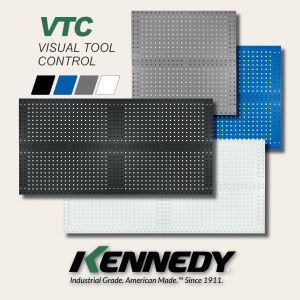
Kennedy® Manufacturing’s steel toolboards were designed specifically to address these shortcomings. Built with industrial-grade steel and equipped with a secure locking tool holder system, Kennedy® toolboards provide a safer, more durable, and more accountable approach to workplace organization.
The Hidden Safety Risks of Traditional Pegboards
For decades, shops have relied on pegboard systems made from compressed fiberboard or lightweight materials. While these products may work adequately in a hobby garage, they frequently become problematic in demanding industrial environments.
Traditional pegboards face several issues:
- Material degradation due to humidity and temperature changes
- Sagging under heavier tool loads
- Cracking around mounting holes
- Hooks that fall out unexpectedly
- Hooks that come off with the tool
- Difficulty maintaining tool accountability
- Increased risk of dropped tools
Fiberboard products absorb moisture over time, which can weaken the structure and cause warping. Industrial maintenance areas often experience fluctuating temperatures, oil exposure, and varying humidity levels that accelerate deterioration.
Once a pegboard begins to weaken, hooks no longer remain securely seated. A wrench, pliers, screwdriver, or specialty instrument can unexpectedly fall, creating hazards for both personnel and equipment.
In facilities where safety audits and lean manufacturing practices are priorities, these deficiencies become increasingly difficult to justify.
Why Steel Construction Matters
Kennedy® takes a fundamentally different approach by utilizing steel toolboards designed for industrial environments.
Steel offers several advantages over traditional pegboard materials:
Long-Term Structural Integrity
Unlike wood-based products, steel does not disintegrate with age. It resists cracking, splitting, and deterioration that commonly affect fiberboard alternatives.
A steel toolboard installed today can continue performing reliably for years, even in demanding production environments.
This durability provides several operational advantages:
- Reduced replacement costs
- Improved worker confidence
- More consistent tool organization
- Enhanced workplace appearance
- Reduced downtime associated with damaged storage systems
Organizations making long-term investments quickly recognize that buying a durable solution once often costs less than repeatedly replacing lower-quality alternatives.
Resistance to Industrial Conditions
Manufacturing facilities present challenges that consumer-grade storage products simply were not designed to handle.
Steel toolboards can withstand:
- Vibration from nearby machinery
- Exposure to industrial environments
- Heavy daily use
- Repeated tool removal and replacement
- Impact from carts and equipment
Rather than gradually deteriorating, steel construction helps maintain consistent performance year after year.
Improved Fire Resistance
Another important consideration is fire safety.
Unlike fiberboard and plastic materials, steel is non-combustible. While a toolboard alone does not eliminate fire risks, choosing non-combustible storage components can support broader facility safety initiatives.
For many industrial customers, this additional layer of protection provides valuable peace of mind.
The Problem with Conventional Tool Hooks
Material durability is only one aspect of toolboard safety.
The other major challenge involves retaining tools securely.
Anyone who has used a conventional pegboard has experienced the frustration of accidental hook removal. A worker grabs a tool, and the hook comes out with it. The hook may then fall to the floor, forcing the user to reinstall it.
While this may seem like a minor inconvenience, the cumulative effects are significant:
- Lost productivity
- Increased frustration
- Potential dropped tools
- Poor workplace organization
- Greater chance of misplaced equipment
In critical environments, these small inefficiencies add up rapidly.
Kennedy’s Locking Tool Holder Advantage
One of the most significant features of Kennedy® toolboards is the locking tool holder mechanism.
Rather than relying on simple friction-fit hooks, Kennedy®’s system is designed to lock tool holders securely into position.
This creates a number of important benefits.
Enhanced Safety
When tool holders remain locked in place, workers can remove and replace tools without accidentally dislodging the holder itself.
The result is:
- Fewer dropped objects
- Reduced trip hazards
- Improved worker confidence
- Greater storage reliability
In busy industrial environments, every reduction in risk matters.
A tool that remains properly secured is less likely to fall onto machinery, finished products, sensitive instruments, or personnel below.
Improved Tool Accountability
Many facilities operate under strict tool accountability requirements.
Industries such as:
- Aerospace
- Defense
- Power generation
- Utilities
- Transportation
- Precision manufacturing
must often maintain close control over tools.
A secure locking tool holder system helps support these efforts by ensuring that storage locations remain consistent and organized.
Workers can immediately identify missing tools, improving accountability and reducing search times.
Supporting 5S and Lean Manufacturing Initiatives
Many organizations have adopted Lean and 5S methodologies to improve workplace efficiency.
The 5S system focuses on:
- Sort
- Set in Order
- Shine
- Standardize
- Sustain
Toolboards are a foundational component of these initiatives because they create visible, designated storage locations.
Kennedy® steel toolboards support 5S efforts by helping organizations:
- Create standardized tool locations
- Minimize wasted motion
- Improve visual management
- Reduce search times
- Maintain workplace consistency
Because the steel panels resist deterioration, they help sustain organizational improvements over the long term.
This durability plays an important role in maintaining continuous improvement programs long after implementation.
Easier Safety Audits and Inspections
EHS managers, supervisors, and maintenance leaders regularly conduct facility inspections.
Disorganized tools often generate findings related to:
- Housekeeping
- Tool accountability
- Workplace safety
- Operational efficiency
A properly designed steel toolboard system can help eliminate many of these concerns.
Benefits include:
- Clearly visible tool locations
- Immediate identification of missing equipment
- Reduced clutter
- Improved housekeeping
- Better overall workplace presentation
Visitors, customers, auditors, and inspectors often view organized workspaces as indicators of a well-managed operation.
Kennedy® toolboards help facilities project that professional image.
Protecting Valuable Tools
Many maintenance departments invest thousands, or even tens of thousands, of dollars in professional-grade tools.
Improper storage can shorten the lifespan of these assets.
Tools left in drawers become piled together. Tools left on benches become misplaced. Tools hung on weak pegboards may fall and suffer damage.
Kennedy®’s steel toolboard system provides:
- Dedicated storage positions
- Secure retention
- Easy visibility
- Reduced impact damage
- Better overall tool care
Protecting high-value tools helps organizations maximize their equipment investment while reducing replacement expenses.
Better Ergonomics for Employees
Employee ergonomics represent another important aspect of workplace safety.
When workers can quickly locate tools at eye level and within easy reach, they spend less time:
- Bending
- Reaching
- Searching
- Climbing
- Repositioning tools
The result is a more efficient and comfortable work environment.
Workers can focus on completing maintenance tasks rather than searching through drawers or storage cabinets.
Even small ergonomic improvements can contribute to reduced fatigue and improved productivity over time.
An Ideal Solution for Industrial Facilities
Kennedy® steel toolboards are well suited for a wide variety of applications, including:
Manufacturing Facilities
Production maintenance teams require quick access to commonly used tools while maintaining organized workstations.
MRO Operations
Maintenance, repair, and operations departments benefit from improved accountability and tool visibility.
Government Facilities
Military, municipal, and federal organizations often prioritize durable products made for long service life.
Utility Companies
Field support and maintenance centers require rugged organization systems that withstand daily use.
Aviation Maintenance
Aircraft maintenance operations place a premium on tool control and accountability.
Educational Training Centers
Technical schools and vocational programs benefit from organized, professional-grade tool storage systems that reinforce best practices.
Built for Decades, Not Just Years
One of Kennedy® Manufacturing’s longstanding strengths is its commitment to producing industrial-grade storage products designed for demanding applications.
The same philosophy that has made Kennedy® tool chests, cabinets, and storage systems trusted throughout industry is reflected in their steel toolboard offerings.
Rather than viewing a toolboard as a disposable accessory, Kennedy® approaches it as an essential part of an organization’s productivity and safety infrastructure.
The result is a storage solution engineered for:
- Reliability
- Durability
- Accountability
- Workplace safety
- Long-term value
Conclusion
Tool organization is about much more than appearance. It directly impacts safety, productivity, accountability, and operational efficiency. While traditional pegboards may seem adequate initially, their tendency to crack, sag, disintegrate, and lose tool retention capability can create significant problems over time.
Kennedy®steel toolboards eliminate these weaknesses by providing industrial-grade durability that resists deterioration and maintains structural integrity for years of service. Combined with a locking tool holder mechanism that keeps accessories securely in place, these systems help reduce workplace hazards, improve tool accountability, and support lean organizational practices.
For organizations committed to creating safer, more efficient work environments, Kennedy® toolboards represent a practical investment in both people and performance. When every tool has a secure place, and every storage component is built to withstand the realities of industrial use, the entire operation benefits from improved safety, organization, and confidence.