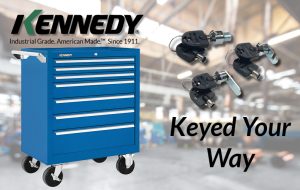
When managing a facility, maintenance department, manufacturing plant, military installation, utility operation, or government project, tool storage security is about far more than simply locking a toolbox. Organizations must balance access control, accountability, productivity, and asset protection across multiple employees, shifts, departments, and locations.
One of the often-overlooked advantages of working with Kennedy® Manufacturing is the ability to configure tool storage solutions with lock systems that meet the specific needs of your operation. Whether you need every toolbox keyed alike for convenience or uniquely keyed for maximum security, Kennedy® has the flexibility to support facility-wide projects of virtually any size.
For organizations purchasing multiple toolboxes, cabinets, mobile workstations, or chests, the ability to specify locking configurations can make a significant difference in both efficiency and security. Let’s explore how keyed-alike and keyed-different solutions can benefit your operation and why Kennedy® Manufacturing remains a trusted partner for industrial storage projects.
The Growing Importance of Tool Storage Security
In today’s industrial environments, tool storage is no longer just about organization. Facilities face increasing pressure to safeguard valuable equipment, control inventory, reduce replacement costs, and maintain accountability.
The loss of critical tools can create several challenges:
- Production delays
- Increased replacement expenses
- Safety concerns
- Inventory discrepancies
- Reduced employee productivity
- Compliance issues in regulated environments
As tool inventories grow in both size and value, controlling access becomes increasingly important. The lock system selected for tool storage often plays a critical role in achieving those objectives.
Understanding Keyed-Alike Configurations
A keyed-alike system means multiple storage units operate with the same key.
Imagine a maintenance supervisor responsible for twenty different Kennedy® tool cabinets spread throughout a manufacturing facility. Rather than carrying twenty different keys, the supervisor can access every designated cabinet using a single key.
This approach offers several benefits.
Simplified Access
One key can unlock multiple storage units, reducing the burden on employees who require access to several tool storage locations throughout the day.
Personnel no longer waste time searching for the correct key or managing large key rings. This translates into greater efficiency, especially in maintenance, repair, and operations environments where quick access to tools is essential.
Easier Key Management
Facility managers often oversee dozens or even hundreds of locking storage units.
A keyed-alike configuration helps streamline:
- Key issuance
- Employee onboarding
- Supervisor access
- Spare key management
- Key replacement programs
This reduction in complexity can save administrative time while minimizing the risk of misplaced or incorrectly assigned keys.
Ideal for Department-Level Control
Many facilities choose keyed-alike configurations for specific departments.
For example:
- Maintenance department storage
- Tool crib cabinets
- Facilities management toolboxes
- Quality assurance equipment storage
- Mobile maintenance carts
Employees within a department can access approved storage units without requiring separate keys for each box.
When Keyed-Different Makes More Sense
While keyed-alike systems offer convenience, some facilities prioritize security and accountability above all else.
A keyed-different configuration assigns a unique lock and key combination to each storage unit.
This approach provides a higher level of individual control.
Increased Accountability
When each toolbox has its own unique key, organizations gain clearer ownership and responsibility.
Individual employees can be assigned specific storage units, making it easier to determine:
- Who has access
- Who is responsible for inventory
- Where tools belong
- When shortages occur
This level of accountability can be particularly valuable in highly regulated or mission-critical environments.
Better Asset Protection
Certain employees may require access only to the tools they use.
Unique keying limits unnecessary access while helping reduce the possibility of:
- Unauthorized borrowing
- Tool loss
- Inventory discrepancies
- Cross-shift confusion
Facilities that maintain expensive precision instruments, specialty tooling, or calibrated equipment often prefer this approach.
Enhanced Security for Sensitive Applications
Keyed-different solutions are commonly used in:
- Aerospace facilities
- Defense contractors
- Government installations
- Utility operations
- Research laboratories
- Specialized manufacturing environments
In these settings, controlling access to equipment is often a critical operational requirement.
A Hybrid Approach for Larger Facilities
One of the greatest advantages of specifying lock configurations during a Kennedy® toolbox project is flexibility.
Many organizations find that a hybrid solution offers the best balance between convenience and security.
For example:
Department-Based Keying
Each department operates under its own keyed-alike grouping.
Examples might include:
- Maintenance Team A
- Maintenance Team B
- Facilities Department
- Quality Department
- Production Support Team
Within each group, a common key works across multiple storage units. Between departments, however, keys remain unique.
Supervisor Override Strategies
Facilities can also designate select storage units for supervisory access while maintaining unique keys for employee toolboxes.
This structure provides:
- Operational flexibility
- Controlled access
- Employee accountability
- Reduced security risk
Project-Specific Lock Configurations
Large industrial projects often require dozens or even hundreds of storage units.
Kennedy® Manufacturing can support project-specific requirements that align with the customer’s access policies and operational workflows.
Whether the requirement is all boxes keyed alike, all boxes keyed differently, or strategically grouped keying arrangements, planning lock configurations at the time of purchase helps ensure a seamless deployment.
Why Key Planning Matters Before Purchase
Many buyers focus on the size, color, drawer capacity, and mobility of tool storage while overlooking lock requirements.
Unfortunately, lock planning after installation can become more complicated and costly.
Early planning allows organizations to address:
Personnel Access
Who needs entry to which storage units?
Shift Coverage
Will multiple shifts share storage locations?
Facility Expansion
Will additional storage units be added later?
Contractor Access
Will temporary personnel require controlled access?
Security Policies
Are there customer, military, or compliance requirements governing tool control?
Answering these questions early helps establish a lock strategy that supports long-term operational needs.
Supporting Government and Institutional Projects
Kennedy® Manufacturing has extensive experience serving industrial customers, military users, educational institutions, and government organizations.
Many of these projects require:
- Large quantities of storage units
- Consistent product specifications
- Access control planning
- Long lifecycle expectations
- Secure equipment storage
The ability to specify locking arrangements becomes especially valuable when deploying storage systems across numerous buildings, departments, or field locations.
Whether supporting a military maintenance operation, municipal fleet garage, public utility, or manufacturing plant, properly planned keying configurations help improve both security and efficiency.
Reducing Downtime Through Better Access Management
The true cost of poor access control often extends far beyond replacing a lost key.
Consider the impact when:
- Employees cannot access critical tools
- Supervisors spend time locating keys
- Tool inventories become disorganized
- Maintenance activities are delayed
A thoughtfully designed keying program helps reduce these disruptions.
When technicians know exactly where tools are stored and can access them quickly, productivity improves and downtime decreases.
For facilities operating around the clock, those time savings accumulate rapidly.
Kennedy’s Commitment to Industrial Durability
Of course, lock configurations represent only one part of the overall value equation.
Kennedy® Manufacturing’s reputation has been built on producing industrial-grade storage designed for demanding work environments.
Customers continue to choose Kennedy® because of features such as:
- Heavy-duty steel construction
- Durable finishes
- High-capacity drawers
- Precision storage organization
- Long service life
- American manufacturing heritage
When paired with a lock system tailored to the customer’s access requirements, these storage solutions become an even more powerful asset management tool.
Choosing the Right Keying Strategy
Determining whether to select keyed-alike or keyed-different configurations depends on your organization’s priorities.
Choose Keyed-Alike If:
- Convenience is paramount
- Multiple employees access the same storage units
- Administrative simplicity is important
- Department-wide access is desired
- Large groups of cabinets need common access
Choose Keyed-Different If:
- Accountability is critical
- Individual ownership is required
- Tool security is a top concern
- Sensitive equipment is stored
- Access must be tightly controlled
Final Thoughts
Every facility has unique security, workflow, and access-control requirements. That’s why a one-size-fits-all approach to tool storage locking systems rarely delivers the best results.
Kennedy® Manufacturing’s ability to provide storage solutions that can be keyed alike, keyed differently, or configured as part of a customized facility-wide access strategy gives organizations valuable flexibility when planning tool storage investments.
Whether you’re equipping a maintenance department with dozens of matching cabinets, assigning individual toolboxes to skilled technicians, or managing a large-scale government or industrial project, the right lock configuration can improve efficiency, enhance accountability, and protect valuable assets.
By considering keying requirements during the planning and purchasing process, facilities can ensure their Kennedy® tool storage system works not only as an organizational solution, but also as an effective component of their overall security strategy.
